As seen on BlenderNation…

ShareTextures hosts a variety of textures. Created primarily for architectural visualizations, the textures are CC0.
Free and open source software for the planetarium dome and other immersive environments.
Planetarium professional since 1992. User of Free and Open Source Software since 2001.
As seen on BlenderNation…
ShareTextures hosts a variety of textures. Created primarily for architectural visualizations, the textures are CC0.
I shared this previously on Facebook, but I’m back to the project.
The blend file is available here:
https://github.com/waystar/Sample-Blend-Files
Drop me a line if you want the PNG frames with alpha background.
I might try some of these, since I want to step up my node-based procedural textures game!
 |
| From nodevember.io |
I won’t have time to do them all, but I’ll try to some of them. I will of course be using Blender, but any procedural/node based software can be used.
The 2019 annual meeting of the Great Lakes Planetarium Association was held last week, hosted by the Ritter Planetarium of The University of Toledo.
It was special for me because my planetarium career started at Ritter Planetarium in February 1992. Honestly I had planned to stop conducting workshops for a few years so that I could concentrate on my GLPA executive community duties. But Alex Mak asked so of course I said yes.
The result is a very revised version *NEW!* for Blender 2.8:
https://github.com/waystar/2019-Blender-Workshop-Materials
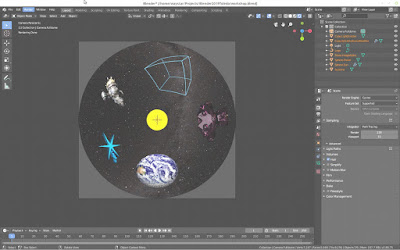
https://github.com/waystar/2019-Blender-Workshop-Materials
Click the “Clone or download” button to download the whole thing in a zip file.
Drop me a line if you find mistakes or OS-related differences. (I test on Linux and Windows.) Also, let me know if you find any of it particularly useful and I would LOVE to see what you make.
And of course, if you are having trouble with something in particular that you are trying to do, let me know. If I can’t help get it to work, I might be able to suggest alternate approaches to get the same effect.
I ran across this by accident today. I don’t yet have a dual camera setup to work with, but I want to be prepared. I ran across a discussion thread talking about the software and then the thread turned to sadness with a post that the company making it had folded. Then at the end was another post linking to another thread cheering the revival of the software as an open source project with the MIT License.
Honestly it has been a few years since I’ve built my own packages. Hopefully I can satisfy the dependencies through package managers at least. (If I had time to compile everything, I would still be running Gentoo. It ran mighty fast, but compiling time added up.)
If and when I manage to trying it out, I will be sure to update.
I am still here, I promise! Been away from work and prepping for the upcoming GLPA conference.
In the midst of all that, I’ve been taking the Coursera class mentioned last month. Although the instructors emphasize Houdini because that’s what they use for cinematic rendering, they do mentioned Blender frequently. I have installed the apprentice version of Houdini (yay for Linux version!) but haven’t had time to learn it. Thus I am doing the assignments in Blender.
Solar System render from specific assignment parameters using textures provided.

The instructors are doing a great job of breaking down concepts and using those concepts as they explain how and why they decide on approaches to their work. The quizzes are challenging and thought provoking.
In my own work, I mostly create science illustrations rather than visualizations. Even so, I find myself putting more focused thought into my work now. And I like that. I like that a lot.
It’s not solely FOSS stuff, but I’m taking this course:
I’m half-watching these and listening as I do other things, pausing to note differences from 2.79 that I know will trip me up.

From the official Blender YouTube channel
https://www.youtube.com/playlist?list=PLa1F2ddGya_-UvuAqHAksYnB0qL9yWDO6